
Strategic Roadmap For the CFO Transition

To successfully transition from a senior finance leader (like EVP of FP&A) to a Chief Financial Officer (CFO), a leader must shift from managing execution to driving strategy. This transition requires a deliberate restructuring of time, team, and tools to ensure the leader is "stepping into the room" as a peer to the C-suite and a strategic partner to the Board.
The following document outlines the tactical steps and organizational structures necessary to facilitate this rise, based on established executive practices.
1. Executive Presence and Cross-Functional Integration
The primary shift in mindset involves communicating as a CFO before officially holding the title. This requires engaging with other CXOs on their own terms:
Technological Integration: When engaging with the CTO, the focus should be on the specific requirements of the finance tech stack and how it supports broader business objectives.
Strategic Interrogation: When working with strategy leads, the focus must be on translating high-level goals into financial implications.
Leveraging the Incumbent CFO: To demonstrate value, the EVP should allow the current CFO to lead in their areas of strength while the EVP focuses on filling existing gaps in the organization’s financial or operational strategy.
2. Optimizing the FP&A Team Structure
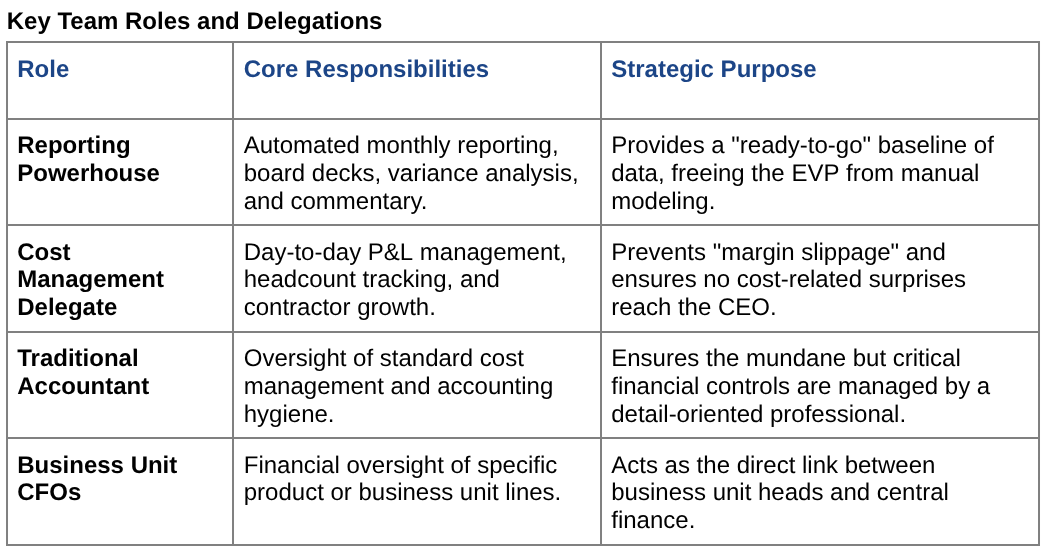
To rise to the CFO level, an EVP must delegate non-essential execution tasks. A high-performing FP&A department should be divided into specialized roles that allow the leader to remain focused on high-level strategy.
3. The Long-Range Model: The Indispensable Strategic Tool
The most critical tactical asset for an aspiring CFO is the Long-Range Model (LRM). Unlike management reporting, which is historical and operational, the LRM is a forward-looking, high-level strategic tool.
Sole Ownership: The EVP must maintain sole ownership of this model. While team members handle quarterly and annual updates, the EVP builds and controls the 3-to-5-year outlook.
KPI Focus: The model should focus on the most sensitive levers that drive the business's valuation multiple, including:
Customer retention rates and new customer acquisitions.
Product-by-product P&L and growth.
High-level revenue and cost dynamics.
Board-Level Impact: The LRM is used primarily for scenario planning (e.g., modeling 8%, 10%, or 12% growth) during strategy sessions and board meetings. By connecting revenue growth to cost dynamics in a way that business unit heads cannot, the EVP becomes indispensable to the CEO and the Board.
4. Strengthening Internal Alliances
A transition to CFO requires intelligence that goes beyond standard FP&A reports.
The Controllership Connection
A strong, direct relationship with the Controller is essential. Because the controllership team sees every transaction, they can flag anomalies before they reach the current CFO or CEO.
Post-Close Reviews: Establish monthly meetings with the controllership team to identify unusual items, such as fraud risks, revenue collection issues, or overpayment of bonuses.
Credibility Building: Being the first to escalate a problem—and proposing a solution—builds immense credibility with the C-suite.
Business Unit Relationships
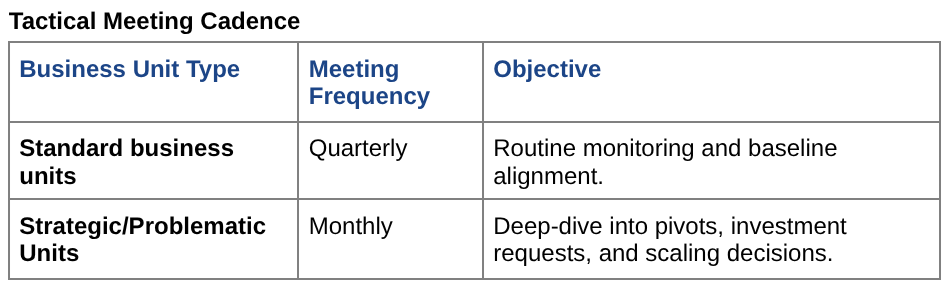
Rather than spreading focus equally across all departments, the EVP should prioritize relationships based on strategic risk and opportunity.
High-Growth Areas: Focus on these to advocate for necessary investments that drive expansion.
Struggling or Loss-Making Units: Focus on these to drive "hard conversations" regarding plateaued products, potential shutdowns, or the reallocation of staff.
5. Transitioning from Execution to Strategy
The final tactical shift involves moving from "listening in" to "setting the strategy."
When business units present growth plans, the aspiring CFO must challenge the baseline assumptions. Instead of simply accepting investment requests, the leader asks: "What are you trying to achieve in the first year? What baseline will help you get there?" By using the Long-Range Model as a background guide, the leader can confidently propose pivots, whether to invest more aggressively or to scale down underperforming segments.
This approach demonstrates a deep comprehension of business drivers and an "investment thesis" mindset, which are the hallmarks of a successful CFO.
