
Coachable by Ric Bucher — How the Greatest Performers Reach Their Highest Potential
Ric Bucher's Coachable explores the psychological and operational mechanics of high performance across professional sports, translating those lessons into universal strategies for personal and professional leadership. Bucher defines coachability not as passive obedience, but as an active, collaborative synthesis between an individual's personal aspirations and an external guide's objective vision of their untapped potential.
Achieving peak performance requires balancing confidence (belief in one's capacity) with humility (recognition of one's limitations). Without that balance, talent creates an artificial ceiling — turning natural strengths into crutches that mask critical vulnerabilities.
The synthesis, in short: Confidence and humility, held in balance, produce a mutual execution plan between performer and coach — and that plan is what sustains high performance over time.
1. The Mechanics of True Coachability
The Formula: Coachability = Personal Vision + External Perspective + Mutual Execution Plan.
The Ego Trap: Relying solely on natural strengths builds a fragile identity. High performers actively seek external perspectives to expose and fix underlying flaws before those flaws are exploited under high-stakes pressure.
Curiosity over Incompetence: Reinterpreting the Peter Principle, an individual's ultimate professional ceiling is defined not by fixed talents, but by the depth of their curiosity regarding every dimension of their field.
2. Mindset & Psychological Frameworks
Harmonious vs. Obsessive Passion: Harmonious passion is driven by intrinsic love for the craft, fostering resilience, adaptability, and long-term sustainability. Obsessive passion is driven by extrinsic validation and outcome-fixated results, frequently leading to burnout, anxiety, and brittle performance.
Decoupling Identity from Performance: Athletes and executives suffer acute distress when their self-worth is entirely tied to professional output. The person must always be broader than the role.
Reframing Mistakes (The 50% Rule): As demonstrated by Roger Federer's point-win ratio, elite performance doesn't require flawless execution. It demands an immediate mental reset — forgetting the previous error and focusing entirely on the next action.
3. Strategic Realignment Lessons from Elite Athletes
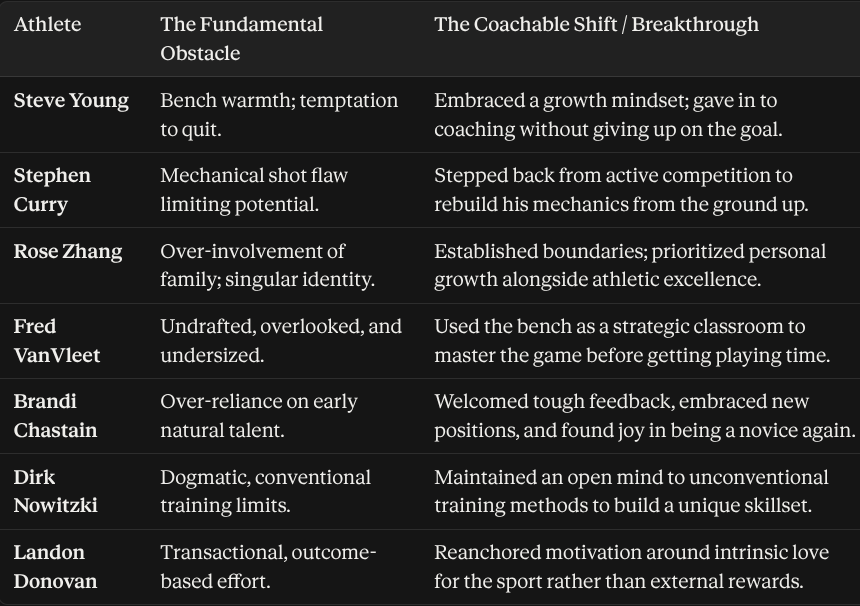
Key Takeaways for Executives, Advisors, and Investors
Focus on the Message, Not the Delivery: Disregard the communication style of the source; extract the actionable insight regardless of how unpalatable the feedback feels.
Step Back to Fix Core Flaws: Continuing to operate with a known structural flaw compounds risk. Temporarily reducing output to rebuild a core skill yields exponential long-term returns.
Practice Active Gratitude: Counteract the brain's natural fight-or-flight stress response under pressure by consciously anchoring yourself in gratitude for the opportunity to perform.
Command Respect Through Preparation: When sidelined or out of power, use the vantage point to study system dynamics so you can execute flawlessly when given the opportunity.
Conserve Emotional Energy: Avoid extreme physiological swings from wins or losses; steady energy reservation ensures sustained performance over a long career.
Final Reflection
What separates Coachable from a standard sports-leadership book is Bucher's insistence that coachability is not submission — it's a negotiated, mutual process between someone who wants to grow and someone positioned to see what they can't see in themselves. For executives and investors alike, the through-line is the same one that shows up across every profile in this book: the ceiling isn't talent. It's how much curiosity you're willing to bring to your own blind spots, and whether you're willing to trade the illusion of already knowing for a plan that actually gets you there.
This reflection is an independent summary of themes from Coachable: How the Greatest Performers Reach Their Highest Potential by Ric Bucher. Readers are encouraged to read the full book for complete context.
