
The Essential Wooden by John Wooden and Steve Jamison—What Elite Leaders Get Wrong About Success
There is something unusual about John Wooden.
He is widely considered the greatest coach in college basketball history:
10 national championships. 7 in a row.
88-game winning streak
12 Final Fours in 14 years
And yet, he never told his team to go out and win.
That contradiction is the starting point of The Essential Wooden.
Success Is Not Winning
Wooden’s definition of success is one of the most misinterpreted ideas in leadership:
Success is the peace of mind derived from knowing you made the absolute effort to become the best you are capable of becoming.
This shifts everything.
From:
outcomes
scoreboards
recognition
To:
effort
preparation
execution
Winning, in Wooden’s world, is not the goal. It is the by-product.
The Real Job of a Leader
Wooden did not see himself as a coach. He saw himself as a teacher.
Leadership, in his framework, is:
building people
building character
building teams
Not:
chasing outcomes
managing optics
reacting to results
A leader’s job is simple to describe and difficult to execute: Bring out the best in others, consistently.
The Pyramid of Success
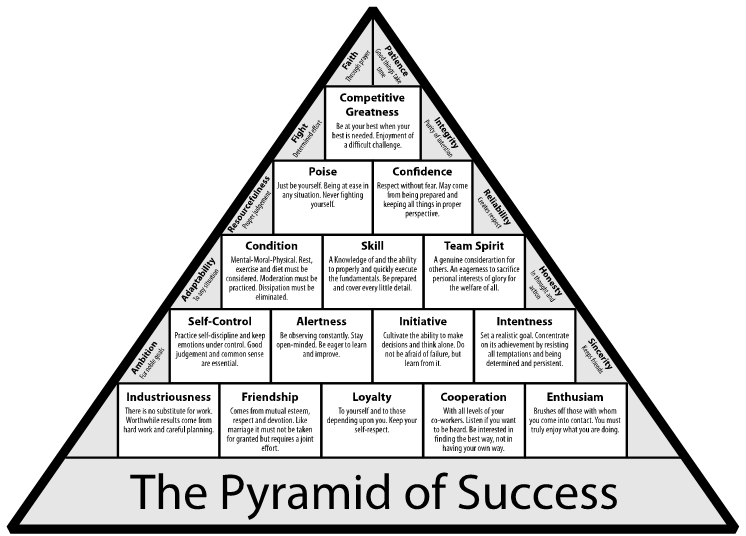
Success is not an event. It is a structure. And most professionals try to skip layers.
Effort Over Outcome
Wooden believed:
You cannot control the outcome
You can control your preparation and effort
In modern environments, this gets reversed.
Professionals:
obsess over results
compare constantly
react to outcomes
Instead of asking: Did I operate at my full capability?
This is where performance becomes unstable.
Effort creates consistency. Outcomes fluctuate.
Worry vs Concern
One of Wooden’s most practical distinctions:
Worry
emotional
draining
out of your control
Concern
analytical
actionable
forward-moving
Elite performers replace worry with concern.
They do not ignore problems. They work them.
Preparation Creates Confidence
Wooden was obsessive about preparation. Every minute of practice was planned.
Because:
Confidence is not personality. It is memory of preparation.
In high-stakes environments:
perfection is impossible
mistakes are guaranteed
The difference is:
who is prepared to respond
Team First, Always
The star of the team is the team.
Wooden emphasized:
sharing credit
sharing responsibility
playing for something larger than yourself
In leadership today, the same question applies:
Do you:
build others
share information
elevate the team
Or:
protect your advantage
The best teams are not driven by individual brilliance. They are driven by shared commitment.
Character Is the Edge
Some things cannot be taught:
character
discipline
integrity
But they can be reinforced.
Wooden’s standards were clear:
never cheat
never steal
never make excuses
Not because they sound good.
Because over time, character compounds into trust.
Leadership Is Emotional Control
Wooden rejected:
intimidation
volatility
emotional swings
He emphasized:
calm strength
consistency
self-control
If you cannot control your emotions, they will control you.
This is especially relevant in high-pressure environments where:
reactions are visible
decisions are amplified
Composure is not passive. It is disciplined.
Teaching That Sticks
Wooden followed a simple model for learning:
Explanation
Demonstration
Imitation
Repetition
Most leaders stop at explanation. Great leaders:
demonstrate
correct
reinforce
Until behavior changes.
Mistakes Are Part of the Process
Teams that make mistakes usually win. Because:
they are pushing limits
they are learning faster
they are operating at the edge
Avoiding mistakes often means:
avoiding growth
Balance and Perspective
Wooden constantly emphasized perspective:
Don’t let what you can’t control affect what you can
Ignore excessive praise and criticism
Stay grounded
Because leadership without balance leads to:
emotional volatility
poor judgment
inconsistent performance
Trust and Environment
Trust begets trust. Wooden created environments where:
people felt supported
expectations were clear
accountability was consistent
And he understood: Environment shapes behavior more than instruction.
The Core Lesson
At its core, The Essential Wooden is not about basketball.
It is about a different way to define success.
Not:
winning
status
recognition
But:
Consistent effort toward realizing your full potential, in service of something bigger than yourself.
What This Means for Leaders
For advisors, investors, and operators, the translation is direct:
1. Redefine Success
Measure effort and preparation, not just outcomes.
2. Build Systems, Not Moments
Success is built daily, not decided in one event.
3. Lead Through Teaching
Don’t just explain. Develop others.
4. Prioritize Team Over Self
Long-term performance is a team outcome.
5. Stay Grounded
Ignore noise. Focus on what you control.
Closing Thought
Wooden never told his teams to win. He told them to prepare, to improve, and to give their best.
And over time: They won anyway.
