Build by Tony Fadell — An Unorthodox Guide to making Things Worth Making
I found ‘Build — An Unorthodox Guide to making Things Worth Making’ by Tony Fadell to be a guide to leadership, productive struggle, and an uncompromising standard of excellence—a powerful internal and external roadmap for my partners: Executives, Investors, and Advisors.
Most management books promise clean frameworks for predictable corporate environments. They treat leadership as an exercise in optimization. But Build by Tony Fadell is written from the perspective of an engineer, executive, and founder who built the iPod, the iPhone, and Nest. Fadell approaches leadership not as a corporate science, but as an unorthodox discipline forged through catastrophic mistakes, intense pressure, and hard-fought operational battles.
The book is organized into six sequential parts:
Build Yourself
Build Your Career
Build Your Product(and I would add "or Your Service")
Build Your Business
Build Your Team
Becoming CEO
I found this sequence powerful because I also noticed an inherent, cyclical nature to what he proposes. Before you can build a product or service, you have to build judgment. Before you can build a business, you have to understand the customer. Before you can build a team, you have to learn how to manage yourself. Before you can become CEO, you have to understand what the seat actually requires. And then you start over again as you rise to the next level or move to the next opportunity.
At its core, Fadell’s operating rhythm is simple: Do. Fail. Learn.
Human nature does not change regardless of what you are building, how old you are, or how much capital you hold. True leadership is not about managing spreadsheets or hiding behind processes; it is about guiding teams through productive struggle, making hard calls with and without data, and maintaining an uncompromising standard of excellence.
Summary Takeaways for Senior Leaders
Earn your judgment through productive struggle: Real capability is built by getting your hands dirty, failing, analyzing the mistake, and trying again.
Look up and look around: Transition from a functional expert to a systems thinker by understanding how every part of the organization impacts the ultimate customer journey.
Separate outcome from process: Hold teams strictly accountable to the quality of the output, while giving them the space to determine how they achieve it.
Do not use data as a crutch for vision: Data informs V2, but vision drives V1. Use insights and storytelling to make opinion-driven decisions under ambiguity.
Prototype the entire journey: The product is not just the physical object or software interface; it is the entire experience from initial awareness to long-term support.
Anticipate organizational breakpoints: Redesign communication channels and team structures before scaling friction causes operational paralysis.
Protect mission over perks: Align teams around real customer pain points, human empathy, and rigorous execution rather than superficial comfort.
1. Real Learning Requires Productive Struggle
Fadell’s early career was shaped by high-profile failure. At General Magic, an ex-Apple team built the precursor to the smartphone in the early 1990s. It had extraordinary talent, a powerful vision, and groundbreaking technology. But the product was too early, the market was not ready, and the customer problem was not yet clear.
The experience was brutal, but it taught him something that cannot be learned from theory: you cannot skip productive struggle.
Traditional education treats failure as a terminal score: you study the book, take a test, and if you fail, you receive a bad grade. In the real world, there is no textbook, no pre-packaged answers, and no grade. Failure is often the beginning of real understanding.
Early in a career, the primary objective must never be title, prestige, or cash compensation. The primary objective is answering a single question: What do I want to learn?
Inaction is the only true failure: In your early building years, inaction is the only true failure. The rest is trial and error.
Productive struggle as a growth engine: Humans do not learn by having answers handed to them on a platter. Real capability is formed through productive struggle: trying, screwing up, analyzing the mistake, and altering the approach next time.
Hands-on execution over thin advice: Highly paid advisory roles or management consulting can offer a broad, two-dimensional view of business. Without getting your hands dirty, failing, and putting things back together when they break, you never gain a three-dimensional operational instinct.
It was hard for me to read his view above—and it will be for many of you reading this—but there is truth to it.
What I would add is that I have always viewed the capitalist ecosystem as a single, cohesive unit. At the center sits the Core Planet—the company directly solving a customer problem. Orbiting around it are the Satellites—the investors, advisors, and service providers who enable and accelerate that mission.
As an engineer at the start of my career, and now as a founder, it has been deeply gratifying to build systems, services, and technology—breaking them and learning from both the process and the people. That maturation process (and the thrill that comes with it) is unparalleled.
As an investment banker (and for my advisor and investor partners), you are building, failing, and learning within the capital markets layer of the ecosystem. As you gain a broad view across dozens of businesses over many live transactions, you begin to recognize valuable operational patterns as well as how the market perceives and prices those businesses. (The reality that traditional incentive structures and transactional timelines often prevent this group from staying longer and diving deeper with a single company is a discussion for another day.)
When Apple called Fadell to build the iPod, he knew exactly how to do it because he had spent a decade struggling and failing to build mobile devices.
2. Look Up and Look Around
Individual contributors often operate looking straight down. They focus on the immediate task, deadline, and deliverable. That focus is necessary, but it becomes dangerous if it remains their only operating model.
To transition into enterprise leadership, you have to look up and look around for roadblocks and opportunities.
Looking Up: Understanding where the company is going, what the ultimate goal is, and what roadblocks sit in the long-term path.
Looking Around: Getting out of your functional or domain silo and understanding the teams around you: marketing, sales, support, manufacturing, legal, finance, design, and customer experience.
For advisors and investors, "looking around" means speaking across MDs/Partners in other sub-sectors, engaging product partners (M&A, Corporate Banking, Equity/Private Capital Markets, DCM, LevFin, Sponsors), and collaborating with in-house operating partners.
Every function inside a company is someone’s customer and someone’s supplier. Every internal handoff either improves the customer experience or creates friction. The high performer who only looks down remains an individual expert. The leader who looks up and around becomes a systems thinker.
3. The Transition to Management: Standards vs. Micromanagement
Becoming a manager is a distinct discipline that requires abandoning the exact habits that made you a star individual contributor. You are no longer responsible for writing the code or designing the hardware; you are responsible for human beings.
At least 85% of a manager's time must be spent managing. One of the hardest parts of this transition is separating high standards from micromanagement.
Being exacting and holding a team to high standards is not micromanagement. A leader should care deeply about output quality, push for excellence, and ask hard questions. It turns into micromanagement only when a leader dictates the step-by-step process of creation rather than holding the team accountable to the resulting output.
The outcome is the manager’s business. How the team reaches the outcome is the team's business.
If the process is flawed and leads to bad outcomes, the manager must step in to adjust it. Otherwise, let go of the step-by-step execution, but keep your hands on the wheel.
Furthermore, a leader’s mood acts as an amplifier across an organization. Unmanaged anxiety, frustration, and fear leak into daily interactions and bounce around the office ten-fold. Leading requires gaining emotional distance between what you feel internally and what you express externally. Your emotional tone becomes your team's operational tone.
4. Data vs. Opinion: Making Hard Calls in Ambiguity
One of the most practical distinctions Fadell introduces is the divide between data-driven and opinion-driven decisions.
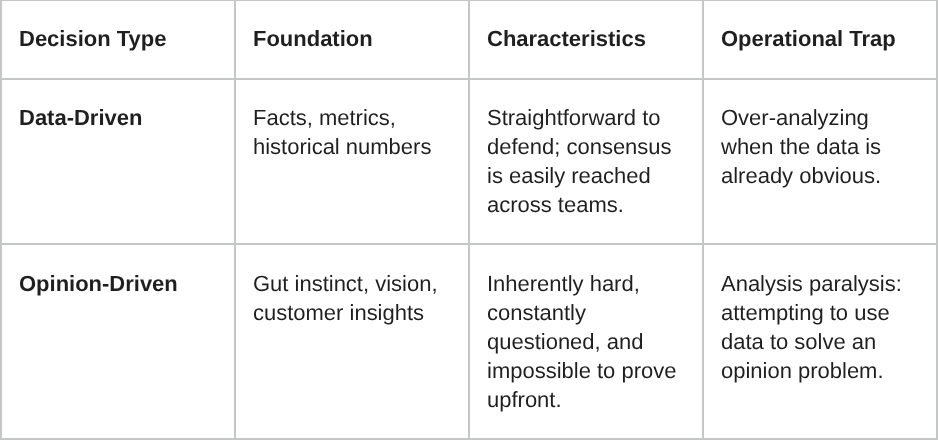
When creating something genuinely new, definitive data does not exist. Attempting to run customer panels or endlessly A/B test core product concepts is an act of fear. Data in those moments is not a guide; it is a crutch to avoid personal accountability. Customer panels cannot design step-function innovations because people can only express preferences based on what already exists.
Opinion-driven choices cannot be settled by consensus or democracy. A leader must gather insights, listen to inputs, consult experts, trust their gut, make the call, and accept full responsibility for the consequences.
Decisive leadership is not a dictatorship either. Leaders must walk the team through the data examined, the insights gathered, and the exact reasoning behind the intuition so the team can align and execute.
5. Storytelling as Leadership Infrastructure
When data is incomplete and a team, board, or market is hesitant to take a leap of faith into the unknown, the primary operational tool is storytelling.
A good story appeals to both the emotional and rational sides of the brain. It takes complicated technical or business concepts and makes them simple.
The "WHY" drives the "WHAT": Long before detailing technical specifications or features (the what), leaders must articulate why the solution needs to exist and why anyone should care.
Infecting the audience with the "virus of doubt": Effective positioning begins by reminding people of an existing, daily frustration. You re-ignite their annoyance with the status quo until they realize their current setup is unacceptable.
Steve Jobs mastered this when introducing the iPhone by first detailing how frustrating traditional smartphones were. Once the audience is infected with that doubt, they are open to a new vision.Analogies as cognitive bridges: Complex concepts require shorthand analogies to translate deep expertise into instant understanding. When Nest created a feature to balance grid load, they didn't write a long technical manual. They named it "Rush Hour Rewards" and used a simple graphic of a car on a highway.
Storytelling is how vision travels. It is how you recruit talent, raise capital, align internal teams, and convince customers to buy.
6. Mission-Driven Leadership vs. Toxic Culture
Organizations frequently confuse passionate, demanding leaders with toxic jerks. Fadell breaks workplace behavior into four clear categories:
Political Assholes: Absent during real work and hard choices, but swoop in to say "I told you so" or take credit. They protect themselves, collect dirt, and kill good ideas.
Controlling Assholes: Micromanagers who choke creativity, resent ideas they didn't originate, and demand total compliance to satisfy their egos.
Asshole Assholes: Mean, insecure people who are bad at the work and create misery for its own sake.
Mission-Driven Leaders ("Mission-Driven Assholes"): Individuals possessed by an intense passion for the output. They push experts past comfortable boundaries, challenge assumptions, and refuse to tolerate mediocrity.
Pushes for greatness do not make someone an asshole. Not tolerating mediocrity does not make someone an asshole. Challenging assumptions does not make someone an asshole.
The distinction lies in intent: controlling assholes manipulate people for their own ego; mission-driven leaders push people for the benefit of the customer and the work.
When dealing with controlling or political assholes who block execution, the operational sequence is clear: Kill them with kindness → Ignore them → Go around them → Quit.
7. Prototype the Whole Customer Journey
When creating a new product or service, the physical object, digital software, or delivered service is only one tiny part of a much larger user journey.
Makers often build a prototype of the core object and think they are done. You must prototype and map the full customer experience across seven key touchpoints: Awareness, Education, Acquisition, Onboarding, Usage, Support, and Loyalty.
Customers experience this entire journey step-by-step. If a single link breaks, the whole product fails.
When building the Nest Learning Thermostat, early testing revealed that customers took over an hour to install the unit, largely because they couldn't find the right screwdriver in their homes. To fix this, Fadell insisted on including a custom, high-quality, pocket-sized screwdriver with four interchangeable bits in every Nest box.
It added $1.50 per unit in cost—highly controversial for a hardware startup. But it was not a hardware cost; it was a marketing and support investment. It turned installation anxiety into a moment of confidence and delight, leaving a branded tool in the customer's kitchen drawer for years.
8. The Rhythm of Building: Evolution, Disruption, and the Three-Generation Arc
Building a sustainable business requires balancing three distinct modes: Evolution (incremental improvement), Disruption (changing the status quo with a novel approach), and Execution (flawlessly delivering on promises).
Companies often calcify because they become obsessed with protecting their original innovation. True leaders are willing to cannibalize their own cash cows, just as Apple created the iPhone knowing it would eventually kill the iPod.
Furthermore, turning a disruptive concept into a profitable, lasting business typically takes three generations over 6 to 10 years:
V1 (Make the Product): Unprofitable. Driven by single-minded vision and customer (early adopter) insight to test if the core idea matters.
V2 (Fix the Product): Achieves unit economics and gross margin profitability. Iterates based on real usage data and customer feedback as the product crosses the chasm to the early majority.
V3 (Build the Business): Reaches net margin profitability. Optimizes business models, supply chains, CAC/COGS, and mass-market distribution.
Many large organizations kill great ideas because they demand V3 net profitability from a V1 product before it has even had the chance to learn from early adopters.
To keep execution tight across these generations, teams need heartbeats (rhythms). Constraints breed creativity, and the best constraint is time. Any brand-new product (V1) should ship within 9 to 18 months. Beyond V1, an organization should maintain a steady external heartbeat, releasing meaningful updates to the market 2 to 4 times a year.
9. Organizational Breakpoints
As an organization scales, its communication channels, operating habits, and management cadence inevitably break. Leaders must anticipate and redesign structure before these friction points cause gridlock:
1–15 People: Flat & Informal (Organic decisions; max span of control)
15–45 People: Sub-Teams Form (First management layer added)
45–120 People: Managers of Managers (HR brought in-house; formal leveling)
120–300+ People: Dedicated Business Units (Cross-functional pods required)
To protect culture during growth, Fadell advocates for the Three Crowns System in hiring: requiring unanimous approval between the hiring manager and the managers of two internal cross-functional "customers" who will rely on the candidate's output. If all three do not agree, the candidate is a pass.
When onboarding new executives, provide positive micromanagement during their first 30 days to ground them in cultural norms, key relationships, and operational expectations rather than dropping them into the deep end.
10. The CEO's Work: Standards, Governance, and Mission Over Perks
Being CEO means moving from an actor or director to a producer: setting the operational tone, maintaining standards, and driving alignment.
Almost any competent team can get a project to 90% execution. The hardest part of leadership is bridging the gap between 90% good and 100% excellence through relentless care and attention to detail.
A CEO must also maintain clear operational hygiene across governance and culture:
Managing the Board: Run board meetings with a strict "no bad surprises" policy. Conduct individual 1-on-1 prep calls with board members prior to meetings to walk through data, answer questions, and build consensus in advance.
Mission over Perks: Essential benefits (healthcare, competitive compensation, parental leave, retirement support) build long-term retention. Lavish, gimmicky perks (free massages, gourmet novelties) breed entitlement, reduce perceived value to zero, and distract from the core mission. Keep the team grounded in customer reality.
Unbecoming CEO: A founder or CEO should step down when the skills required to scale the company no longer match their personal passions or strengths. Transitioning out requires building an internal succession pipeline well before a crisis, defining clear boundaries, giving the new leader full operational authority, and taking 12 to 18 months to process the transition.
Final Thought
What makes Build exceptional is its refusal to sanitize the operational reality of innovation. Leadership is not a series of neat victories or smooth product launches. It is a relentless cycle of overcoming setbacks, making high-stakes decisions under extreme uncertainty, and taking responsibility when things fall apart.
In the end, only two things endure: the products and services you build, and the people you build them with. Pushing for greatness, solving real human problems, and helping team members realize capabilities they never knew they possessed is what makes the struggle worth enduring.
This reflection is an independent summary of themes from Build by Tony Fadell. Readers are encouraged to read the full book for complete context.
